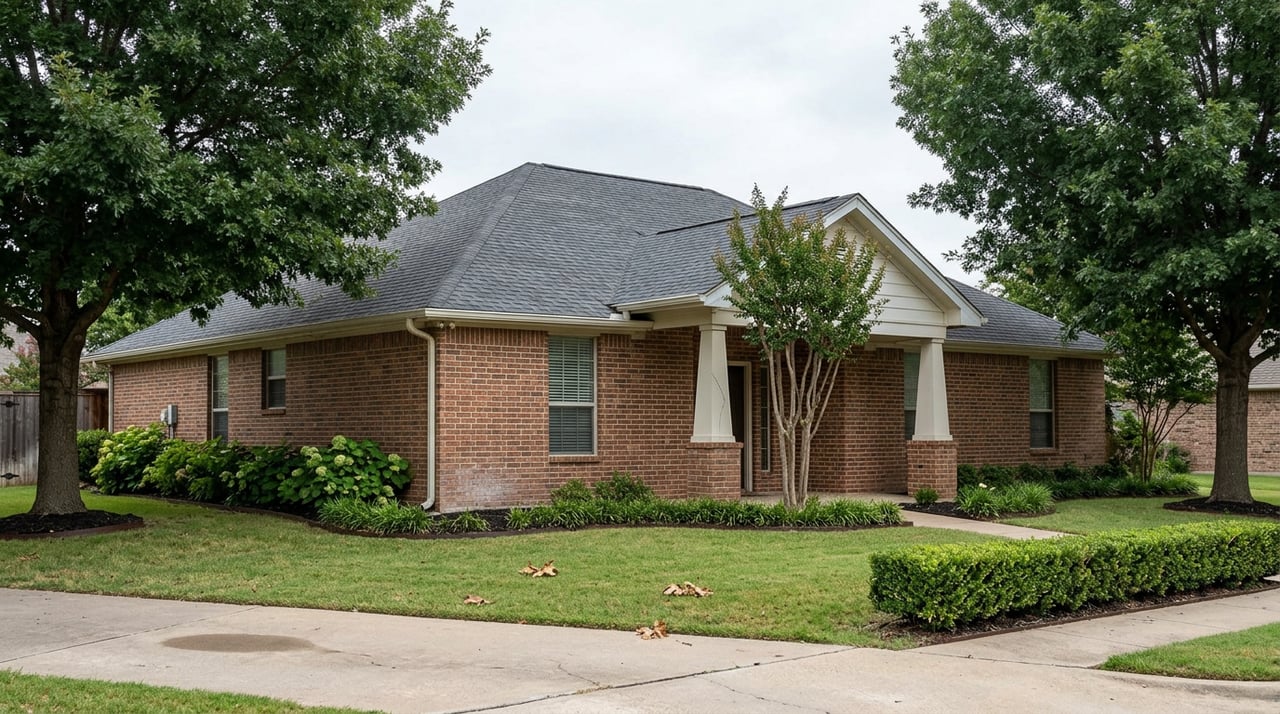
Benton vs Bryant Arkansas Home Prices in 2026
August 27, 2026
August 27, 2026
A buyer comparing a $250,000 listing in Benton to a $290,000 listing in Bryant usually explains the difference the same way: better schools cost more, and Benton is the value play for anyone willing to trade a district's reputation for a lower payment. That math has been true in Saline County for years. It just stopped being the whole story sometime in the last twelve months, and the numbers that would tell you so don't show up on the listing page.
Here is the friction. If you're pricing a move between these two cities right now, you're not comparing a stable premium against a stable discount. You're comparing two markets whose growth rates just crossed, in a county where the retail corridor both cities depend on doesn't respect the city line separating them, and where the newest, most talked-about development in either town just landed on the "cheaper" side of that line.
As of January 2026, Benton's median sale price sat at $245,000, up 19.5 percent from the year before, based on 25 homes sold that month. Bryant's most recent median sale price read, from May 2026, was $270,838, down 6.0 percent year over year. Read on their own, those two numbers look like noise. Small cities produce small sample sizes, and a median built on two or three dozen closings can swing hard from one month to the next just because of which houses happened to sell.
That's exactly why the more useful number isn't either city's single-month median. It's the year-over-year growth ranking Redfin published for Arkansas cities using a broader window through June 2026: Conway led the state at 19.7 percent, Benton came in second at 18.0 percent, and Bryant followed close behind at 17.5 percent, with Little Rock at 17.3 percent. Bryant still carries the higher price tag. But Benton's appreciation rate, measured over the fuller window rather than one noisy month, has pulled ahead of the city that's supposed to carry the premium.
That's the part the school-district story doesn't account for. A reputation gap can hold steady for a decade while the price gap funding it quietly narrows.
Ask most people where Bryant's commercial identity comes from and they'll point to the shopping center at I-30 and Alcoa Road. It's the state's Target, Best Buy, Kohl's, and Old Navy anchor, recently acquired by Hall Equities Group as a 375,000-square-foot investment property. Everyone in Saline County calls it Bryant's corridor.
It isn't entirely. When the center was first built in the mid-2000s as a $50 million development, a five-acre piece of the site at the southeast corner of Alcoa and I-30 landed inside Benton's city limits, not Bryant's. The distinction barely registers to a shopper walking between stores. It matters more to anyone trying to draw a clean line between "Bryant's growth" and "Benton's growth," because the two have been sharing tax base and traffic count at that intersection since before either city's current housing boom started.
If the commercial engine underneath both markets already blurs the boundary, the idea that Bryant and Benton are two cleanly separate housing markets, one premium and one discount, was always a simplification.
The newest example of that blur is bigger than five acres. A Buc-ee's travel center has been under construction in Benton, and MySaline's local business reporting from May 2026 had residents asking almost weekly when it would open. At the time of that report, dozens of trees still needed planting, the fuel pumps still needed installing, and the signage hadn't gone up, though Buc-ee's itself confirmed the site as its "Benton, AR location" when a reader asked directly.
Whatever the exact opening date turns out to be, the location decision already tells you something. The single largest new commercial draw in the corridor didn't go to Bryant, which has spent two decades building its retail reputation around the Alcoa Exchange. It went to Benton. Sales tax from that site lands in Benton's budget. Traffic counts on that stretch of Alcoa Road will run through Benton's frontage, not Bryant's. None of that shows up in a median price the month it happens, but it's the kind of commercial investment that tends to show up in appreciation rates a year or two later, which lines up with a Benton growth rate that's already outpacing Bryant's.
The clearest sign that Benton and Bryant function as one market wearing two names is the Salt Bowl, the annual football game between Bryant and Benton High Schools that draws roughly 20,000 fans, more attendance than any other high school football game in the state. A rivalry that size doesn't happen between two towns with separate commuter sheds and separate daily lives. It happens between two towns whose residents work the same jobs, shop the same stores, and send their kids to compete against neighbors they see at the grocery store the other fifty-one weeks of the year.
That closeness is exactly what makes the price gap worth scrutinizing rather than accepting at face value. Local real estate observers commonly put the typical price difference for comparable homes somewhere in the $15,000 to $30,000 range, Benton lower. That gap has been treated as the price of Bryant's school district, full stop. But a gap that size, sitting on top of two cities converging in growth rate and sharing a commercial corridor, is a gap worth checking against current data before you assume it will still be there in three years.
If you're choosing between a Benton listing and a Bryant listing at similar price points, you're making two different bets, and it helps to know which one you're actually making.
If the Bryant listing is worth the premium to you because of the school district specifically, that's a defensible reason to pay it. Bryant's district reputation isn't in question here. But if part of your reasoning is "Bryant will always cost more because it's the better overall market," the growth-rate data from mid-2026 doesn't support treating that as a fixed law. Benton's appreciation has been outrunning Bryant's, a major new commercial anchor just chose Benton's side of the corridor, and the retail base that built Bryant's reputation already includes acreage that belongs to Benton on paper.
None of this means Benton is now the better buy in some universal sense, and it doesn't mean Bryant's premium is about to vanish. It means the two markets are closer to each other, in both geography and trajectory, than the standard framing gives them credit for. A buyer who treats the price gap as static risk overpaying for a premium that's shrinking, or underestimating a Benton property whose upside is tied to a corridor still filling in.
Does buying in Benton mean automatically losing access to Bryant schools? School district lines in Arkansas are drawn separately from city limits, not the other way around. Before you rule an address in or out based on its mailing city, confirm which district actually serves that parcel.
Is the price gap guaranteed to keep closing? No. Benton's lead in the year-over-year growth comparison is worth watching, not treating as a forecast. Small-city medians move on a handful of sales, so even a broader window can shift as new transactions come in.
If you're weighing a move between Benton and Bryant and want the numbers run against your specific budget and priorities rather than a general comparison, Lindsey & Krystina Realtors can walk through what a given address, school zone, and price point actually gets you in both markets right now. Schedule a free consultation whenever you're ready to see it mapped out.
Stay up to date on the latest real estate trends.
Lindsey & Krystina Realtors
Lindsey Blaylock
(501) 317-9782
[email protected]
Krystina Bullard
(501) 303-0344
[email protected]